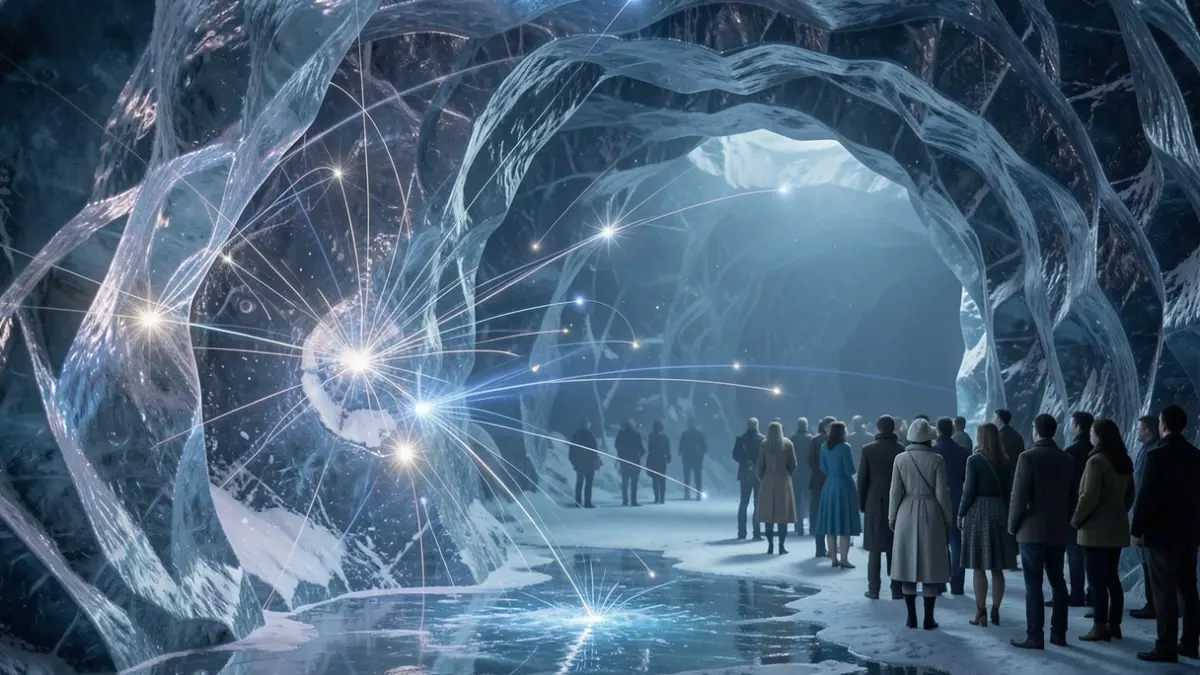
This year's Nobel Prize in Physics was awarded to Belgian physicist Francis Halzen for his groundbreaking work on IceCube, a giant particle detector deep beneath the ice of the South Pole. Brussels scientists have also played an important role in this international experiment for nearly 30 years, opening a completely new window onto the universe. On Wednesday, November 18, the Vrije Universiteit Brussel (VUB) and the Université libre de Bruxelles (ULB) invite journalists to a press conference about the Belgian contribution to IceCube, the discoveries the experiment has made possible, and the future of the research.
IceCube uses over 5,000 sensors deep in the Antarctic ice to search for neutrinos: almost elusive particles that tell us more about the most extreme phenomena in the universe. The joint Interuniversity Institute for High Energies (IIHE) of the VUB and ULB has been involved in the project since 1998.
During the press conference, researchers will look back at their contribution to the Nobel Prize-winning experiment and explain what new discoveries will be possible in the future. Journalists will have the opportunity to ask questions and engage with the researchers.
The morning's program will include presentations on Francis Halzen and the origin of IceCube in Belgium by Profs. Daniel Bertrand (ULB) and Catherine De Clercq (VUB), an explanation of IceCube as a new window to the universe by Prof. Nick van Eijndhoven (VUB), the most important contributions of the IIHE to IceCube by Prof. Juan Antonio Aguilar (ULB), and the future of neutrino and astroparticle physics research by Profs. Krijn de Vries (VUB) and Simona Toscano (ULB).