A new interactive platform developed by VUB researchers visualizes the future of glaciers under different warming scenarios.
By Maxime Goossens
••3 min read
AI
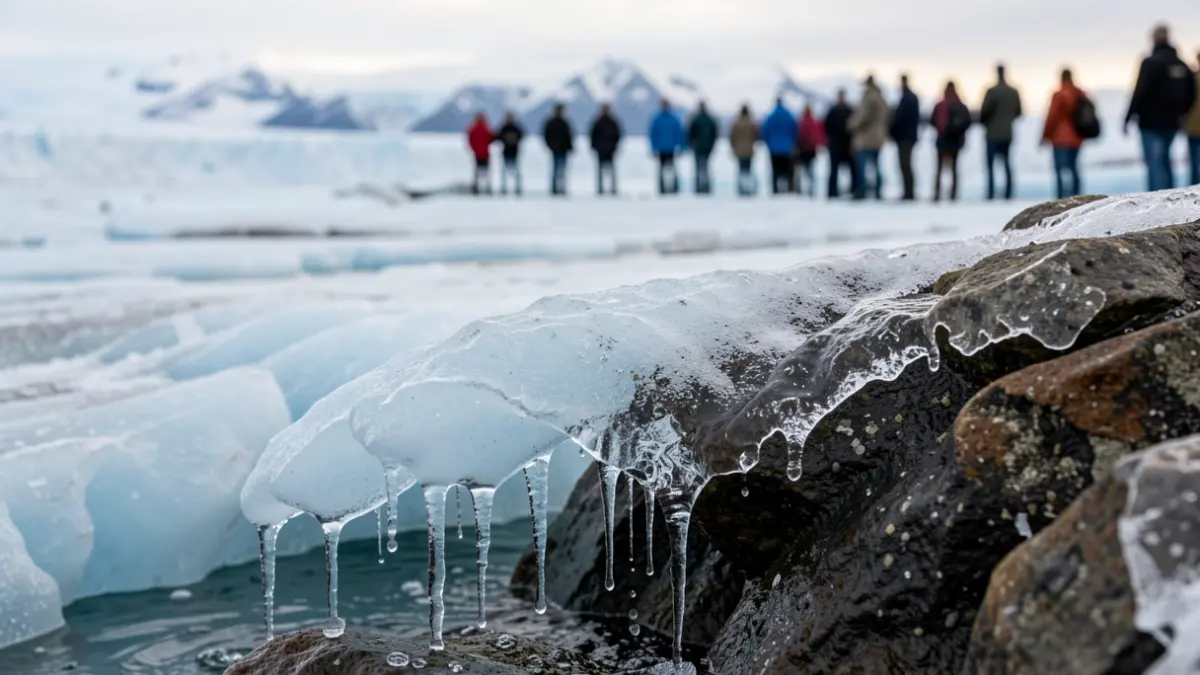
Close-up of a melting glacier edge with water dripping, showing the texture of ice and rock, with a blurred background of a vast icy landscape under a temperate northern sky. Documentary photography style.
The Vrije Universiteit Brussel (VUB) has launched a new interactive platform, the Global Glacier Extinction Explorer, allowing the public to visualize the future disappearance of glaciers worldwide.
A new interactive website, the Global Glacier Extinction Explorer, has been launched by researchers from the VUB. It allows the general public to visualize the predicted disappearance of glaciers across the globe, depending on different levels of global warming. Users can thus check when a specific glacier is likely to vanish.
This platform builds upon a recent study published in Nature Climate Change, led by researchers from ETH Zurich and the VUB. It provides the first global assessment of individual glacier extinctions, highlighting an unprecedented period of glacial loss ahead. The website was developed by lead author Lander Van Tricht (ETH Zurich / VUB) and Kristof Van Tricht (VITO Remote Sensing).
“
"Global figures, like glacier mass or area loss, can feel very abstract. With this website, people can zoom in on their own valley or mountain area and see what different levels of global warming could mean for the glaciers they know. We hope it can also help local communities prepare for a future with fewer glaciers."
The launch coincides with a difficult time for European glaciers. Preliminary observations indicate that 2026 could be one of the worst years for Alpine glaciers since systematic measurements began, due to low winter snowfall and several summer heatwaves. Glaciers like the Bella Tola and Urirotstock in Switzerland have already been declared extinct, confirming the study's predictions.
“
"These examples make the concept of glacier extinction very concrete. Our predictions showed that many small alpine glaciers are nearing the end of their existence, and we are now witnessing this process in real-time. Bella Tola is particularly remarkable because its observed disappearance falls precisely within the extinction window predicted by our models."
“
"The disappearance of a glacier is not the result of a single warm summer, but the culmination of decades of cumulative mass loss. Year after year, insufficient snowfall and strong summer melt cause a glacier to shrink gradually until it can no longer sustain itself. However, extreme melt years like 2022 or 2026 can accelerate this final phase."
The underlying study, 'Glacier Extinction', based on global glacier models, estimates that nearly 2,000 glaciers could disappear annually at the peak of extinction under +1.5°C warming, a figure that would double at +4°C. By 2100, only about 10% of current glaciers would remain at +4°C, compared to nearly half at +1.5°C. In the European Alps, only about 20 glaciers might remain at +4°C.
“
"Every fraction of a degree counts. By limiting warming to 1.5°C, more than twice as many glaciers could be preserved by 2100 compared to 2.7°C warming."
Glaciers are more than just large ice masses; they shape landscapes, ecosystems, and water resources, and often hold significant cultural and emotional meaning for local communities. The new platform visualizes these global projections down to the scale at which glacier loss is ultimately experienced: the individual glacier. The disappearance years provide an estimate of when a glacier is likely to vanish and how dependent that timing is on future warming.
“
"Behind every disappearing glacier lies a place, a history, and often a community that will experience its loss. The fact that some of the glaciers predicted to disappear in our study are already vanishing today shows that glacier extinction is not a distant, end-of-the-century problem. It is happening now."
The scientific reference for the study is published in Nature Climate Change (Van Tricht et al., 2026) and The Cryosphere (Zekollari et al., 2024).