VUB Professor Gert Desmet has received the prestigious Tswett-Nernst Award. This international lifetime achievement award recognizes his exceptional contributions to liquid chromatography, a separation technique essential for applications such as detecting pesticides, PFAS, and medical biomarkers. This is a remarkable achievement, especially considering Desmet is not an analytical chemist by training.
Chromatography has existed for over a century. It is a technique used to separate complex chemical mixtures into their individual components. A liquid or gas pushes a sample through a stationary medium (like a tube or column filled with beads). Because molecules have different affinities for this medium, they travel at varying speeds through the system, allowing individual substances to be detected sequentially and accurately. As a civil engineer in chemical process technology, Desmet encountered a practical problem during his doctorate. To solve it, he had to look beyond the boundaries of his own field, leading him to liquid chromatography.
"It turned out to be such a fascinating field with still a lot of unexplored territory that I shifted my full attention to it," says Prof. Desmet. "Because I entered the field as an outsider, I was often able to have a significant impact with an original perspective."
This original approach quickly became evident in his work on pressureless chromatography. While the industry pumps liquids through microscopic particles under extremely high pressures of up to 1500 bar, Desmet theoretically and experimentally proved that it could be done without such immense pressure. "The idea of doing chromatography without pressure really made my name in the field. It wasn't always easy to gain a foothold as an outsider, but it all turned out well."
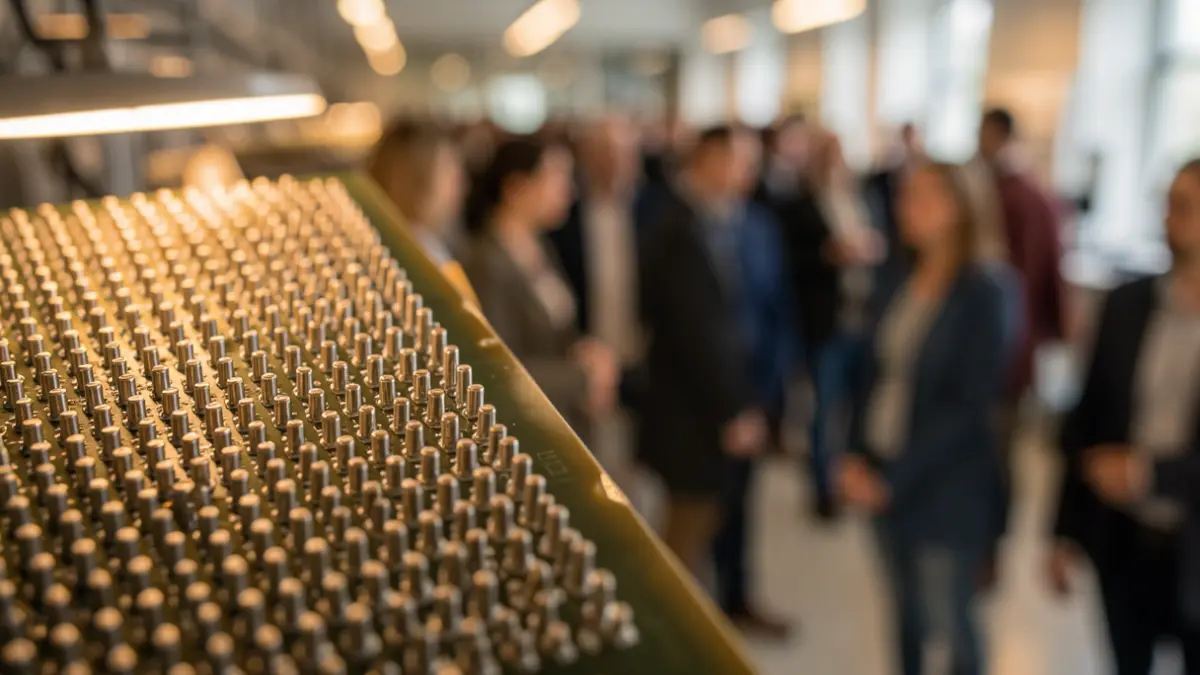
One of his most well-known breakthroughs is the reinvention of the chromatography column. Instead of filling a tube with a messy packing of loose particles, Desmet and his team designed silicon chips on which a tightly ordered network of micro-pillars is created using lithographic etching techniques.
"The art in chromatography is to keep groups of the same molecules as close together as possible," Desmet explains. "With the etching technique, we can fabricate this structure in a perfectly ordered manner."
This invention formed the foundation for PharmaFluidics, a successful VUB spin-off that was later acquired by the international market leader Thermo Fisher Scientific. While the pillars were 5 micrometers at the company's founding, after a generation of 2.5 micrometers, the next step of 1.25 micrometers is now ready.
The societal and industrial demand for faster and more accurate separation techniques is enormous. Consider the identification of biomarkers for cancer screening or the analysis of complex human samples with thousands of different proteins.
To solve these complex puzzles even faster, Desmet is now looking into a new field: artificial intelligence. In collaboration with VUB AI experts Ann Nowé and Pieter Libin, he is working on integrating AI into chromatography.
"Choosing the right chromatographic conditions is a very complex problem for which industry throws a lot of money at it," Desmet explains. "If one gets a sample and finds the right combination of parameters to separate the molecules within two weeks, they have done a good job. But that means two weeks of work with multiple analysts and devices. AI can help us drastically speed up that process."
Despite his decades-long career and the new lifetime achievement award, the researcher's curiosity remains undiminished. "It remains amazing to see how sharp the peaks that pass the detector can be. The fact that molecules of the same type can stay so close together while flowing through a system remains fascinating."